

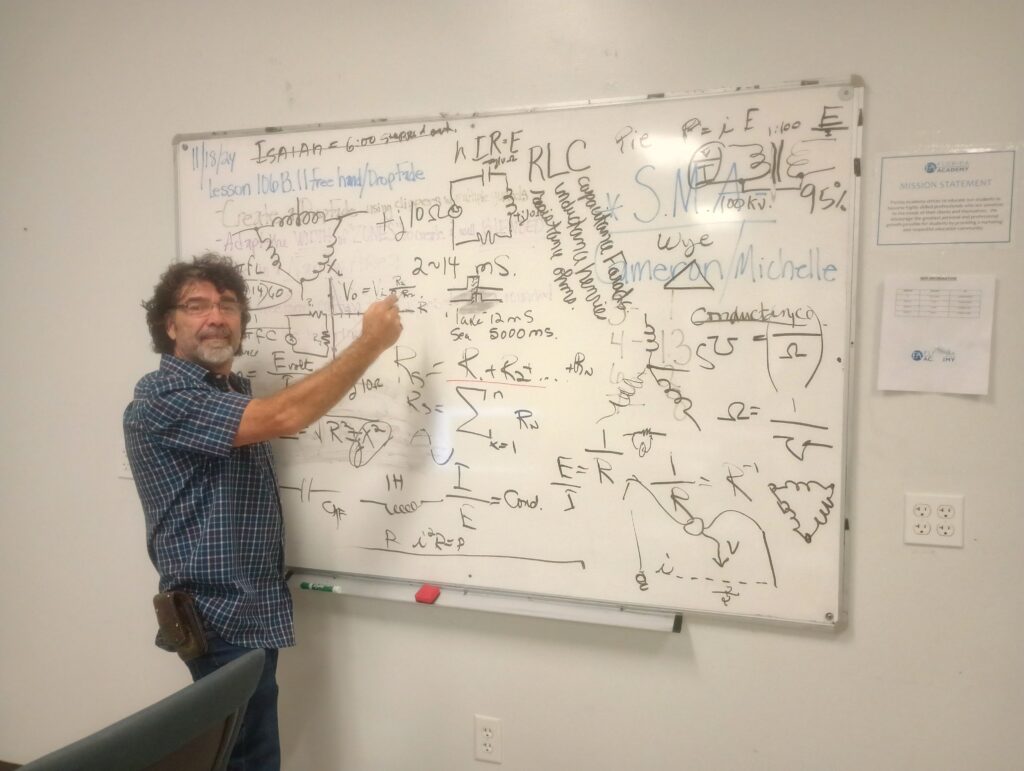
This evening was dedicated to guiding students through the transition from direct current (DC) principles, such as Ohm’s Law, to the more nuanced world of alternating current (AC). The focus was on how reactive components—inductors and capacitors—introduce complexities to voltage and current behavior, especially the phenomenon of phase relationships. Here’s a recap of the key concepts covered, designed to deepen our collective understanding of AC systems.
From DC Simplicity to AC Complexity
In DC circuits, Ohm’s Law provides a straightforward relationship: E=IR. However, when alternating current comes into play, the introduction of frequency changes everything. Components like inductors and capacitors react to changing current, storing energy in magnetic and electric fields, respectively. These behaviors result in voltage and current being out of phase—no longer perfectly aligned as in a DC circuit.
We explored phase relationships in detail, highlighting that:
- Inductive circuits cause current to lag voltage.
- Capacitive circuits cause current to lead voltage.
- In circuits with both inductance and capacitance, reactance (the opposition to AC) determines the phase relationship. If inductive reactance XL and capacitive reactance XC cancel each other out, the circuit becomes purely resistive (I did not introduce resonance), where voltage and current are perfectly in phase.
Voltage Measurements and the Wavelength Factor
A compelling moment came when we discussed why a voltage measurement might read zero across the same wire, even when connected to a live phase.
- Key takeaway: Voltage readings depend on the wire length relative to the wavelength of the AC signal. Since the wavelength of standard power frequencies (60 Hz in the US) is exceptionally long—around 3,100 miles (5,000 kilometers)—a single wire segment represents a negligible fraction of that wave.
This concept scales dramatically: at 60 Hz, about eight full voltage waves could wrap around the Earth’s circumference! The practical result is that reflections and phase shifts are virtually undetectable at everyday circuit lengths.
Wave Reflections and Circuit Dynamics
We examined how voltage waves reflect within a wire and interact with the load. This led to a discussion on current behavior in AC circuits, emphasizing that:
- Current can lead or lag, depending on whether the circuit is predominantly inductive or capacitive.
- The greater of XL or XC dictates the net reactance X and, consequently, the overall impedance Z.
Students were encouraged to visualize the interplay between voltage and current waves, understanding how energy alternates between the electric field of a capacitor and the magnetic field of an inductor.
I²R Losses and Wire Size Selection
Another critical topic was the role of I²R losses in determining wire size. These losses, caused by the resistance of the conductor, are a significant factor in power efficiency and safety:
- Higher current increases I2R losses, necessitating larger conductors to reduce resistance and heat buildup.
- In AC circuits, impedance must also be considered alongside resistance to accurately predict these losses.
By addressing these practical considerations, students connected theoretical knowledge to real-world applications, such as conductor selection in commercial electrical installations.
Takeaways
Tonight’s session reinforced the beauty and complexity of alternating current systems. Key concepts included:
- The phase relationship between voltage and current in AC circuits.
- The significance of reactive components and their impact on circuit behavior.
- How wavelengths of AC voltage waves dwarf everyday wire lengths.
- The decisive role of I²R losses in designing efficient electrical systems.
By connecting theoretical principles to practical scenarios, we bridged the gap between abstract understanding and applied electrical technology. Let’s carry this momentum forward, building a deeper appreciation of AC systems in our upcoming lessons.
Great participation level… Kevin, Vincent, Christian, Isaiah, and Cain… Keep it up guys!